
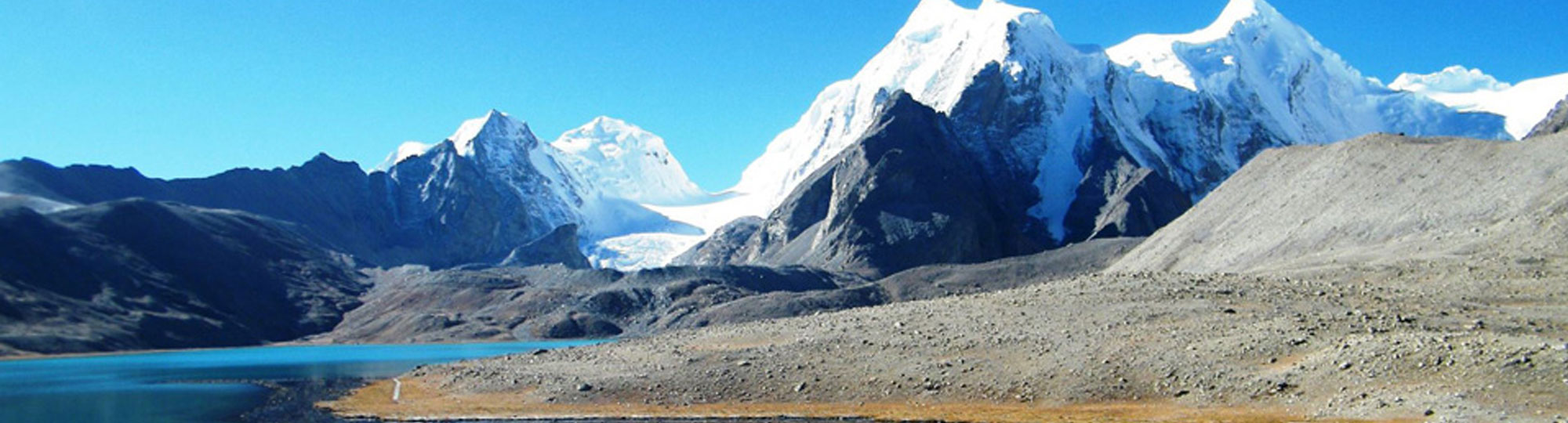
SIKKIM:The Himalayan Shangri-La
GENERAL INFORMATION:
Area: 7096 sq. kms
Language: English, Nepalese, Hindi, Bhutia (Sikkimese), Bhutia (Tibetan), Lepcha, Limboo.
Best time to Visit: May – June and October – November
Capital City: Gangtok
Location
Tucked away in the North eastern part of India nestled between the Eastern Himalayas, Sikkim has come in to state hood just recently. Bordering the Tibet autonomous region to its North, Tibet and Western Bhutan to its East, Eastern Nepal to its West and the Darjeeling Gorkha Hills of West Bengal to its South this tiny little state has a giant guardian in the shape of the third largest mountain on the earth, the Kanchandzonga.
Climate:
In the North of India, surrounded by the snow - clad mountains, Sikkim experiences a cool climate throughout the year. Though most often it is wet with monsoons lashing it down from July to September and even in November and December, the best climate to visit this mall state is summer, May and June. That is the time when Sun shines in abundance throwing open the nature's beauty at galore.
ABOUT SIKKIM
Sikkim is a land of immense scenic beauty, natural charm and a variety of fauna and flora. The word Sikkim in the local language is Su-Khim which means a New or Happy House, and indeed it is! Sikkim has a lot of open monasteries, flying prayer flags and lofty Stupas all giving a tinge of mysticism. Any place you look at in Sikkim definitely leaves you spell bound. The snow clad mountains, the green landscape which broken at interval with the gushing waterfalls. The roaring rivers and the placid lakes, the mountains or the people, you are sure to lose your heart in this beautiful place. Until 1975, Sikkim remained an independent kingdom, ruled by the Chogyal, whose palace is tantalizingly hidden by trees. The modern history of Sikkim begins from 1642 A.D. with the coronation of Phuntsog Namgyal as the first Chogyal or king of Sikkim. Due to the rough terrain, continuous showers and the mountains surrounding the state, the roads leading to Sikkim are not easy. No railway goes to Sikkim, but the nearest airport at Bagdogra in West Bengal is hardly five hours distance form the capital of Gangtok and the picturesque scenery along with the pleasant weather would not bore the first timer! Siliguri junction and New Jalpaiguri Junction are the two closest railway stations (around 120 kms from Gangtok) to this Himalayan state of India. Although Sikkim is a part of India, there are some restrictions for the travelers to venture deep inside the state due to security reasons. The foreign tourists have to obtain permits to travel to this state.
Vindhya and Satpura ranges running east to west in parallel formations traverse almost the entire peninsular India. Parallel across the Western coast are the Sahyadri Mountains. The Eastern coast is also lined with a hill system, irregular though, called Eastern Ghats. Each mountain system is dotted with hundreds of exotic beauty spots made easily accessible and equipped with modern amenities. There are skiing resorts in the Himalayas. Well planned mountaineering treks and river fording sports are also available in Himalayas and elsewhere. Each mountain range has its own peculiar majesty, grandeur and specific geological character. The forests, mostly sub-tropical and some of them perennial, harbour a variety of wild life. There are scores of wild life and bird sanctuaries which provide an exciting glimpse of the jungle world.
Proximity of Sahyadri has created numerous beautiful gorges, fiords, creeks and lagoons shaded by perennial green cover along the Arabian Sea coast particularly in Kerala, Goa and Konkan region of Maharashtra. These provide blissful coves of retreat known for their serene beauty. And the long pristine beaches along the Arabian Sea and also the Bay of Bengal - India has a 7,516 km.-long coastline - provide haven for sun-bathers and lovers of all kinds of water sports. At several places along the backwaters of Kerala traditional rowing tournaments, complete with colourful festivities, fetch rowing buffs and spectators in large numbers.
Down from the snow-topped Himalayas and across the fertile plains of Punjab stretch the undulating sandy deserts of Rajasthan, stark and hot, bereft of greenery and yet known for a riotous celebration of colours. As if to compensate for the nature's chicanery, the people of Rajasthan have created their own world of beautiful colours - the rich textiles, the turbans of men and the flowing ghagaras of women, ornamental embroidery, exquisite jewellery, the huts, the houses and the princely mansions. It is said that every village housewife, every child of Rajasthan is a born artiste endowed with a talent for brush and colour. Miniature paintings of Rajasthan School have admirers across the world. The exotic cities of Rajasthan, Jaipur, Jodhpur, Udaipur, Bikaner known for their harmonious architecture and a superb blend of colours offer a feast to the discerning eye.
But the vibrancy of folk art, colour, folk dance and music is not confined to Rajasthan. It manifests in the harsh terrain of Ladakh, in the colourful life styles of the north-eastern tribes of Arunachal, Sikkim, Meghalaya, Mizoram, Manipur and Tripura and in the tribal belts of Gujarat, Madhya Pradesh, Orissa and Maharashtra. The traditional village fairs, whether in tribal habitats or agricultural villages of the plains, express the quintessential spirit of rural India. A fair is a veritable riot of sound and music, fun and games, feast of local delicacies, songs and dances and a market of astoundingly colourful local handicrafts. A heartening glimpse of a robust and vigorous India of indomitable hope. There are over 700,000 villages in India and thousands of fairs are held annually. Some of these have earned a reputation attracting visitors from all corners of the country and abroad.
PEOPLE
Nepal has a population of more than 18 million people made of different races living in different regions, with diverse culture, languages and dialects. The Gurungs and Magars live mainly in the west. The Rais, Limbus and Sunuwars inhabits the slopes and valleys of the Eastern mid hills. The Sherpas live in the Himalayan region. The Newars constitute an important ethnic group of the capital valley Kathmandu.
There are Tharus, Yadavas, Satar, Rajvanshis and Dhimals in the Terai region. The Brahmans, Chhetris and Thakuris are spread generally over all parts of the Kingdom.