О СШАТУРАГЕНТЫТаджикистан MAHA..INCREDIBLE ИНДИЯИНДИЙСКОГО FESTI..ГостиницыЭкскурсионный пакетПриключенческого тур..Внутренние пакетыГорячая DealsВыставкаСобытияНастроить просмотрTravel GuideМоя t2indiaТуризм СервисНовостиБлогиГостевая книгаФорумOther than Gangtok there are hardly any big towns as such in Sikkim, although a few places are coming up as tourist destinations, especially for trekking. But Sikkim is a religious state and has many followers of the Mahayana and the Tibetan branch of Buddhism. Sikkim's sky line is dotted with such small but pretty monasteries. Sikkim has nearly 200 monasteries or gompas influencing and eventually reflecting the culture and the lifestyle of the people of Sikkim. The Monasteries are the part and parcel of Sikkim and its culture and lifestyle.
1. The Rumtek Monastery:
The most famous Monastery of Sikkim is around 24 kms from Gangtok, the capital of the State. Colloquially known as the Rumtek Dharma Chakra, it is the seat of the Kagyu order on of the major Tibetan Buddhist sects. It was constructed by His Holiness the late 16th Gyalwa Karmapa in 1960 and is believed to be a replica of the original Kagyurpa Monastery in Tsurphu, Tibet.
The Monastery houses some of the world's most unique religious scriptures, manuscripts and religious art objects. At fifteen minutes walking distance is the old Rumtek monastery which was originally built in 1730 by the ninth Karmapa but was destroyed by fire and had to be reconstructed to the present state. Another attraction of this Monastery is the Tsechu dance that is organized in June.
2. Do - Drul Chorten:
Built in 1945, this one of the most important Stupas of Sikkim and also an important tourist destination in Gangtok. It was built by Trulshi Rimpoche, head of the Nyingma order of Tibetan Buddhism. Around Chorten are the 108 prayer wheels and gold-topped shikhara. This highly revered Chorten also has two huge statues of Guru Rimpoche (Guru Padmasambhava) around it.
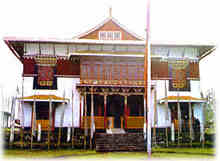
3. Tsuk-La-Khang Monastery:
This monastery is located in the palace premises near the ridge in Gangtok. It is two storied and was used during royal functions like weddings and coronations. The Phang Labsol and the Lossang festivals are celebrated in the ground adjacent to the monastery once-every year with the performance of the 'Chaams' or the masked dances.
4. The Pemyangtse Monastery:
One of the oldest Monasteries in the state the Pemyangtse monastery was built by Lhatsun Chenpo in the 17th century. The earlier small structure was rebuilt later. It was basically built only for the pure monks who could study and stay here. Located at an altitude of 6840 feet it commands a beautiful panoramic view of the Himalayan ranges and the country side. This ancient monastery belongs to Nyigma Buddhism and is considered as one of the premier monasteries, entrusted with the task to perform all the religious tasks of the erstwhile monarch. The monastery houses numerous religious idols and other objects of worship, most of which are precious because of their antiquity. On the top floor of the monastery there is a wooden sculpture depicting the Heavenly Palace of the Maha Guru. This masterpiece was created by Dungzin Rimpoche, and it took five years for completion.
5. The Enchey Monastery:
Although a subordinate to the Pemyangtse monastery, Enchey monastery is also an important seat of the Nyigma order. Hardly three kms from Gangtok this is a 200 year old monastery and is blessed by Lama Drubtop Karpo, a tantric master known for his power of flying. The Chaam or the religious masked dance is performed here every year in January.
6. The Phensang Monastery:
This 300 year old monastery in North Sikkim was gutted by fire in 1947 and was rebuilt in 1948. The actual year of construction of this monastery is 1721, during the time of Jigme Pawo. The devotion of the Lamas and other devotees made it stand again. There are around 300 monks under the monastery and the main annual function in the monastery is in the month of December.
7. The Phodang monastery:
Built by the Chogyal Gyurmed Namgyal somewhere in the first quarter of the eighteenth century, the Phodang monastery is about 28 kms from Gangtok. It is one of the most beautiful monasteries of Sikkim with many murals painted inside. Around 260 monks stay in this monastery to pursue the study in Buddhism.
8. The Tashiding monastery:
The Tashiding monastery carries a legend behind it. Constructed on top of a heart shaped hill with the back drop of the great Kanchandzonga Mountain, it is said that it was this very place from where the Guru Rimpoche blessed the Land of Sikkim. The monastery was built in 18th century by one of the three Lamas who had performed the consecration ceremony for the first Chogyal, the King of Sikkim. It is also said tat the monastery was built on top of a hill that looms up between the Athong and the Rangit River, where a rainbow emanating from Mount Kanchandzonga came to an end.
Other than this Tashiding monastery is more famous for its annual sacred water festival. Bumchu or the sacred water does not dry up nor spoil and continues to have the fresh smell even 300 year later.
Carved skillfully on flagstones surrounding the monastery are holy Buddhist mantras.
Few destinations of Sikkim are gaining prominence due to their abundance in natural beauty and simplicity. The fast life and modernization are yet to overpower these small places and that is what attracts the tourists. A person can enjoy the tranquility, the peace and simplicity in the laps of nature. It's a personal choice to visit these places. One can go trekking or approach them by roads.